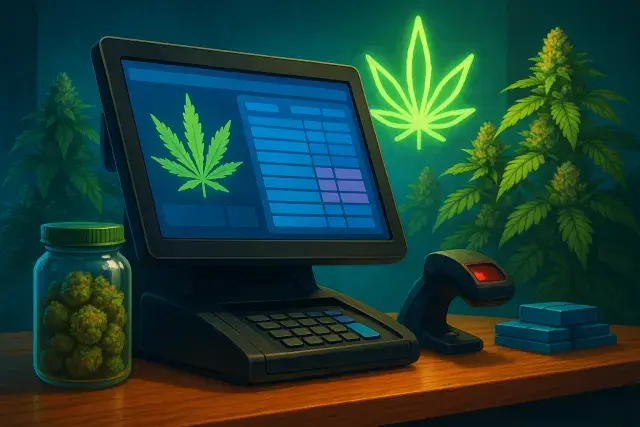

Running a cannabis retail operation without the right point of sale system is like managing a pharmacy with a cash register and a notepad. The compliance requirements alone - real-time inventory reporting, purchase limits, seed-to-sale tracking - would overwhelm any manual process within days. Yet a surprising number of dispensary owners still treat their technology stack as an afterthought, only discovering the consequences when a state audit arrives or a busy Saturday shift turns into a customer service disaster.
Choosing the right dispensary point of sale is one of the most consequential operational decisions a cannabis retailer makes. The wrong system creates compliance gaps, slows down transactions, and produces inventory data you cannot trust. The right one becomes the operational backbone of the entire store. For operators who want to understand what separates adequate from excellent, finding the best dispensary POS solution means evaluating far more than interface design - it means understanding how deeply the software integrates compliance, customer experience, and financial reporting into a single, coherent workflow.
This guide breaks down every major dimension of cannabis retail POS selection: what features actually matter, how compliance integration works in practice, what questions to ask vendors, and how to evaluate total cost of ownership. Whether you are opening your first weed shop or replacing a system that has outgrown your operation, the framework here will help you make a decision you will not need to revisit in eighteen months.
Understanding What a Dispensary Point of Sale Actually Does
More Than a Payment Terminal
The term "point of sale" undersells what modern cannabis retail software actually handles. In a standard retail environment, a POS system processes transactions, tracks product movement, and generates sales reports. In a dispensary, those same functions must operate inside a regulatory framework that varies by state, updates frequently, and carries penalties for non-compliance that can include license revocation.
A purpose-built cannabis retail POS manages customer check-in, verifies identification and purchase limits, interfaces with state tracking systems, processes payment, adjusts inventory in real time, and generates the compliance documentation regulators require - all within the span of a single transaction. Every one of those steps has to work correctly, every time, regardless of transaction volume or staff experience level.
General-purpose retail POS platforms adapted for cannabis often handle the payment and sales reporting functions adequately but struggle with the compliance layer. That gap is where most operational problems originate.
The Core Components of a Cannabis Retail POS
A complete weed shop POS system typically consists of several integrated components:
- Customer-facing check-in and ID verification tools
- Budtender transaction interface with product catalog and purchase limit enforcement
- Real-time inventory tracking connected to back-of-house stock
- State traceability system integration (Metrc, BioTrack, or state-specific equivalents)
- Payment processing module, often built around cashless alternatives due to banking restrictions
- Reporting and analytics dashboard
- Customer relationship management and loyalty program functionality
Each component is only as reliable as its integration with the others. A POS that tracks sales accurately but fails to push those updates to the state traceability system creates a compliance discrepancy that can compound over time into a serious regulatory problem.
Why Generic Retail Software Falls Short
The cannabis industry's regulatory requirements are genuinely unique. Daily purchase limits, potency-based taxation in some states, medical versus adult-use purchase rules, and mandatory seed-to-sale reporting are not features that can be bolted onto a general retail platform without significant compromise. Marijuana dispensary software built specifically for the cannabis industry has these requirements embedded in its architecture - they are not optional modules or workarounds, they are foundational.
Operators who have tried to adapt general retail software to cannabis operations frequently report the same problems: manual workarounds for compliance reporting, inventory discrepancies that take hours to reconcile, and staff training burdens caused by interfaces not designed for the pace of dispensary retail.
Compliance Integration: The Non-Negotiable Foundation
State Traceability Systems and How POS Software Connects to Them
Most cannabis-legal states require dispensaries to report every inventory movement and every sale to a state-mandated traceability platform. Metrc is the most widely used, operating across the majority of adult-use states. BioTrack serves several others. A few states operate proprietary systems. Whatever the platform, your POS must connect to it reliably and push updates automatically.
The integration is not optional. Failure to report accurate, timely data to the state system is a compliance violation regardless of whether your internal records are accurate. When evaluating any cannabis retail POS, ask vendors specifically about their traceability integration: How frequently does data sync? What happens when the state system goes down - does the POS continue to function and queue updates? How are discrepancies flagged and resolved?
These are not hypothetical concerns. State traceability systems experience downtime, and a POS that cannot operate in offline mode or cannot queue transactions for later reporting will grind operations to a halt during those periods.
Purchase Limit Enforcement and Age Verification
Every adult-use state imposes daily purchase limits, typically measured in grams of flower equivalent across product categories. Medical states may have different limits, and some customers hold both medical and adult-use status with different applicable rules. A dispensary that sells a customer more than the legal limit - even accidentally - has committed a compliance violation.
A well-designed dispensary point of sale enforces purchase limits automatically at the point of transaction, with the system preventing the sale from completing if a limit would be exceeded. It should also handle mixed transactions involving multiple product types, calculating the gram equivalents in real time. Age verification integration, typically through driver's license scanning at check-in, should feed directly into the transaction record.
Audit Trails and Documentation
Regulators conducting audits expect complete, exportable records of every transaction, every inventory adjustment, every employee action within the system, and every discrepancy and its resolution. A robust marijuana dispensary software platform maintains these logs automatically, with timestamps and employee attribution for every action.
The practical value of good audit trail functionality becomes apparent only when something goes wrong - an inventory discrepancy, a customer complaint, or an actual regulatory inquiry. Operators who have experienced an audit with incomplete records understand the operational and legal exposure involved. Operators who have experienced one with complete, well-organized records understand why documentation is worth prioritizing at the selection stage.
Dispensary Inventory Management: The Operational Core
Real-Time Inventory Tracking Across Product Categories
Cannabis dispensaries typically carry hundreds of SKUs across categories that include flower, pre-rolls, concentrates, edibles, tinctures, topicals, and accessories. Each product category may have different unit measurements, potency thresholds relevant to purchase limits, and storage requirements. Dispensary inventory management software must handle this complexity without requiring staff to manage it manually.
Real-time inventory tracking means that every sale, every return, and every received shipment updates stock counts immediately. When a budtender sells a half-gram concentrate cartridge, the system should reflect that reduction in inventory within the transaction itself - not in a batch update at end of day. This immediacy is what allows purchase limit calculations to remain accurate across multiple concurrent transactions and what keeps back-of-house and floor stock numbers consistent.
Receiving, Transfers, and Waste Tracking
Inventory management in cannabis retail extends well beyond tracking what is on the shelf. Every product that enters the dispensary must be received against a transfer manifest from a licensed distributor or cultivator, with every unit assigned a state traceability tag. Dispensary inventory management software should make manifest reconciliation straightforward: scanning incoming products, matching them to the manifest, flagging discrepancies, and automatically updating both the internal system and the state traceability platform.
Waste tracking is an often-overlooked element. Products that expire, are returned damaged, or are destroyed for other reasons must be documented and reported correctly. A POS system that handles waste and destruction events properly - including the required state notifications - removes a significant manual compliance burden from operations managers.
Low-Stock Alerts and Reorder Workflows
Stockouts in a dispensary are not merely a lost-sale problem. Customers who arrive specifically for a product that is unavailable may not substitute freely - particularly medical patients who rely on specific formulations. A good weed shop POS system enables operators to set par levels for individual products and automatically generates low-stock alerts or reorder recommendations when stock approaches those thresholds.
More sophisticated systems can analyze sales velocity by product and time period, giving purchasing managers the data they need to make informed reorder decisions rather than relying on intuition or daily manual counts. Over time, this data accumulates into a meaningful picture of customer demand patterns that can inform both purchasing strategy and product curation decisions.
Handling Discrepancies and Reconciliation
Inventory discrepancies - differences between what the system says is in stock and what is physically present - are an operational reality in any retail environment. In cannabis retail, they carry regulatory weight. Unexplained inventory losses must be investigated and documented. A capable cannabis retail POS provides tools for cycle counting, variance reporting, and reconciliation workflows that allow staff to investigate and resolve discrepancies with a complete audit trail attached to the process.
Hardware Considerations for a Weed Shop POS System
Terminal, Tablet, and Mobile Options
The physical hardware of a dispensary POS setup depends heavily on floor plan, transaction volume, and operational model. Large adult-use retail stores with high foot traffic often benefit from multiple fixed terminals - one per budtender station - running full-featured transaction interfaces. Smaller operations or those with a more consultative sales model may prefer tablet-based systems that allow staff to move with customers through the store.
Some marijuana dispensary software vendors offer mobile POS options designed for pop-up events, delivery operations, or outdoor sales during special events. If your operation includes any of those use cases, verify specifically that the mobile version maintains full compliance functionality - not just a stripped-down interface with manual data entry.
Peripherals: Scanners, Printers, and ID Verification Devices
Beyond the primary terminal or tablet, a complete hardware setup for a dispensary typically includes a barcode scanner for product identification, a receipt printer, a cash drawer even in largely cashless operations, and an ID scanner for age verification at check-in. Some operations add a customer-facing display at the transaction counter showing the order in progress and the total.
Compatibility between these peripherals and the POS software is not always guaranteed, particularly for tablet-based systems. Request a specific hardware compatibility list from any vendor you are evaluating seriously, and if possible, visit an operating dispensary that uses the same hardware configuration before committing.
Network and Connectivity Requirements
A cloud-based dispensary point of sale requires reliable internet connectivity for full functionality. Most serious POS vendors build some level of offline capability - allowing transactions to continue processing during brief outages and syncing data when connectivity resumes - but the extent of that offline functionality varies significantly. Understand precisely what your system can and cannot do without an active connection before you experience an outage during a busy shift.
A dedicated, business-grade internet connection with a cellular failover option is a practical investment for any dispensary relying on a cloud-based system. The cost of an afternoon of impaired operations exceeds a year of cellular backup service in most cases.
Key Features to Evaluate When Comparing Vendors
Customer Management and Loyalty Programs
Customer retention is as important in cannabis retail as in any other consumer business. A weed shop POS system with integrated customer relationship management allows staff to access a customer's purchase history during the transaction, making personalized product recommendations practical rather than performative. Loyalty programs - points accumulation, tiered rewards, birthday offers - have demonstrated genuine retention value in cannabis retail markets where competition has increased significantly in recent years.
Verify that the customer data managed by the POS complies with applicable privacy regulations in your state, and ensure that marketing communications generated through the system respect cannabis advertising restrictions, which vary considerably by jurisdiction.
Reporting and Analytics Depth
The reporting capability of a cannabis retail POS determines how much operational intelligence you can extract from your data. Basic systems report revenue by day, product, and category. More capable systems provide gross margin by product, staff performance metrics, peak hour analysis, customer cohort behavior, and basket composition data. The difference between these levels of reporting is the difference between knowing what happened and understanding why.
When evaluating reporting features, think about the specific business questions you need to answer regularly. Which products should you discontinue? Which staff members convert browsing customers into purchases most effectively? What time of day requires the most staffing? A POS system should give you direct answers to these questions, not raw data exports requiring hours of spreadsheet work.
Integrations with Third-Party Platforms
No POS system operates in isolation. A dispensary's technology stack typically includes an online menu platform for product discovery, a delivery management system if applicable, an accounting platform, an HR and payroll system, and potentially a marketing automation tool. The marijuana dispensary software you choose should integrate with the platforms already in your stack - or with credible alternatives you are willing to adopt.
Integration quality matters as much as integration existence. An integration that requires manual data exports or that syncs only once per day creates its own operational problems. Prioritize vendors who maintain documented, actively maintained API integrations with the platforms most critical to your operation.
Staff Access Controls and Training Requirements
Role-based access controls allow operators to limit what different staff members can see and do within the system. Budtenders need transaction access and customer history but should not have the ability to modify inventory records or access financial summaries. Managers need reporting access without necessarily having system administration privileges. These controls are both an operational best practice and, in many states, a compliance requirement related to employee authorization records.
Training time is a real operational cost, particularly in markets with high staff turnover. A complex interface that requires extensive training to use correctly will create ongoing onboarding burdens and increase the risk of staff errors during the learning period. Evaluate how quickly a new staff member can become independently functional with the system.
Evaluating Total Cost of Ownership and Vendor Reliability
Pricing Models and Hidden Costs
Cannabis POS vendors use a range of pricing models. Some charge a flat monthly subscription per terminal. Others take a percentage of transaction volume. Some charge separately for add-on modules like loyalty programs, advanced reporting, or delivery management. Hardware may be sold, leased, or bundled with the software subscription.
When comparing costs, build a complete picture that includes software subscription fees, hardware costs, implementation and onboarding fees, training costs, ongoing support fees, and the cost of any third-party integrations required. A system that appears less expensive on a per-terminal basis may exceed the total cost of a competitor once all components are accounted for.
Contract Terms and Vendor Lock-In
Long-term contracts - common in the POS industry - create switching costs that limit your ability to change systems if the software fails to meet expectations. Annual contracts with reasonable termination clauses are generally preferable to multi-year agreements with steep exit penalties. Understand specifically what happens to your data if you terminate the contract: can you export a complete data archive in a usable format, or does your historical sales and customer data remain inaccessible after leaving the platform?
Data portability is an underappreciated consideration at selection time. Operators who have tried to switch POS systems and found their historical data effectively stranded on the old platform understand its value retrospectively.
Support Quality and Uptime Guarantees
A dispensary point of sale that goes down during a Friday evening rush causes immediate revenue loss and customer experience damage. POS vendor support quality varies enormously - from 24/7 phone and chat support with cannabis-knowledgeable staff to email-only queues with multi-hour response times. Understand exactly what support you are purchasing before committing.
Ask vendors for documented uptime history and their service level agreement terms. A credible vendor will provide this data without hesitation. Ask specifically about how they handle system outages that affect multiple customers simultaneously - which is when support queues are longest and the need is greatest.
Vendor Stability and Industry Track Record
The cannabis technology market has seen vendor failures, acquisitions, and pivots that left dispensaries scrambling to replace critical systems with short notice. When evaluating a weed shop POS system, assess the vendor's business stability alongside its software capabilities. How long have they operated in the cannabis space? What is their customer base size? Have they successfully maintained compliance integrations through state regulatory updates?
Speaking with current customers - not the references the vendor selects - is the most reliable way to assess actual performance. Industry forums, state cannabis association events, and peer networks are practical sources for unfiltered operator feedback.
Making the Final Decision: A Practical Selection Framework
Define Your Requirements Before Talking to Vendors
Vendor sales processes are designed to emphasize strengths and minimize weaknesses. Entering those conversations without a clear, prioritized list of requirements makes it easy to be guided toward whatever the vendor is most confident demonstrating. Before initiating vendor outreach, document your non-negotiable requirements - state traceability integration, specific hardware compatibility, a required third-party integration - and your high-priority features. This list becomes the evaluation rubric that prevents decisions driven by interface aesthetics or sales rapport.
Running a Meaningful Pilot or Demo
A scripted vendor demonstration shows you a best-case scenario. A meaningful evaluation involves running the system against your actual operational scenarios: high transaction volume, a purchase limit edge case, an inventory reconciliation workflow, a compliance report export. If a vendor is unwilling to support this kind of structured evaluation, that reluctance is itself informative.
Some vendors offer limited trial periods or sandbox environments. Where these are available, use them deliberately - have your most experienced staff and your most compliance-focused manager both interact with the system and provide structured feedback.
Planning Implementation and Go-Live
Switching POS systems in a live dispensary is operationally complex. Historical data migration, staff training, hardware installation, and state traceability system reconfiguration all need to happen in a coordinated sequence, ideally without extended downtime. A vendor with a structured implementation process - a dedicated implementation manager, a defined timeline, a clear data migration protocol - significantly reduces the risk of a disruptive go-live.
Plan the go-live for a lower-traffic period if possible. Even the smoothest system transition involves a period of staff adjustment during which transaction speeds and staff confidence are not at their peak.
Frequently Asked Questions
Can I use a general retail POS system for my dispensary if I add a compliance module?
In most cases, this approach creates more problems than it solves. Compliance in cannabis retail is not an add-on feature - it requires deep integration with the transaction engine, inventory system, and reporting infrastructure. Third-party compliance modules sitting on top of general retail software tend to produce sync errors, require manual reconciliation, and struggle to keep pace with regulatory updates. Purpose-built marijuana dispensary software handles these requirements natively.
How does a dispensary POS system connect to Metrc or other state traceability platforms?
Cannabis POS vendors build direct API integrations with state traceability systems. When a transaction is completed, the POS pushes the relevant data - product transferred, quantity, customer ID - to the state platform automatically. Most systems also pull incoming transfer manifests from the traceability platform to streamline receiving. The reliability and frequency of this sync is a critical evaluation point when selecting a vendor.
What should I do if my POS inventory count and my physical count do not match?
Start by running a cycle count on the discrepant SKUs and checking for any unreported transactions, receiving errors, or waste events that were not logged correctly. Most dispensary inventory management platforms include a variance reporting workflow that prompts staff through the investigation steps. Document everything - the discrepancy, the investigation, and the resolution - because regulatory auditors may ask about unexplained variances even if they are eventually reconciled.
How long does it typically take to implement a new dispensary POS system?
For a single-location dispensary switching from an existing system, a structured implementation typically takes two to four weeks from contract signing to go-live. This includes data migration, hardware setup, state traceability system reconfiguration, and staff training. Multi-location implementations take longer. Compressed timelines are possible but increase the risk of data migration errors and staff unpreparedness.
What payment processing options are available for dispensaries given banking restrictions?
Because most major card networks and many banks remain hesitant to process cannabis transactions, dispensaries commonly rely on cash, cashless ATM or debit PIN-based systems, or ACH-based payment platforms. Some cannabis banking solutions have expanded access to traditional merchant processing in select states. Your POS system should support whichever payment methods are legally available in your state and should handle cash management, till reconciliation, and cashless transaction records with equal reliability.
Is cloud-based or locally installed dispensary software better?
Cloud-based systems offer easier updates, remote access to reporting, and lower upfront infrastructure costs, but they require reliable internet connectivity for full functionality. Locally installed systems can operate independently of internet access but require more IT overhead and may receive updates less frequently. Most modern cannabis retail POS platforms are cloud-based with offline transaction capability - this hybrid approach handles the connectivity concern while keeping the operational and maintenance advantages of cloud architecture.