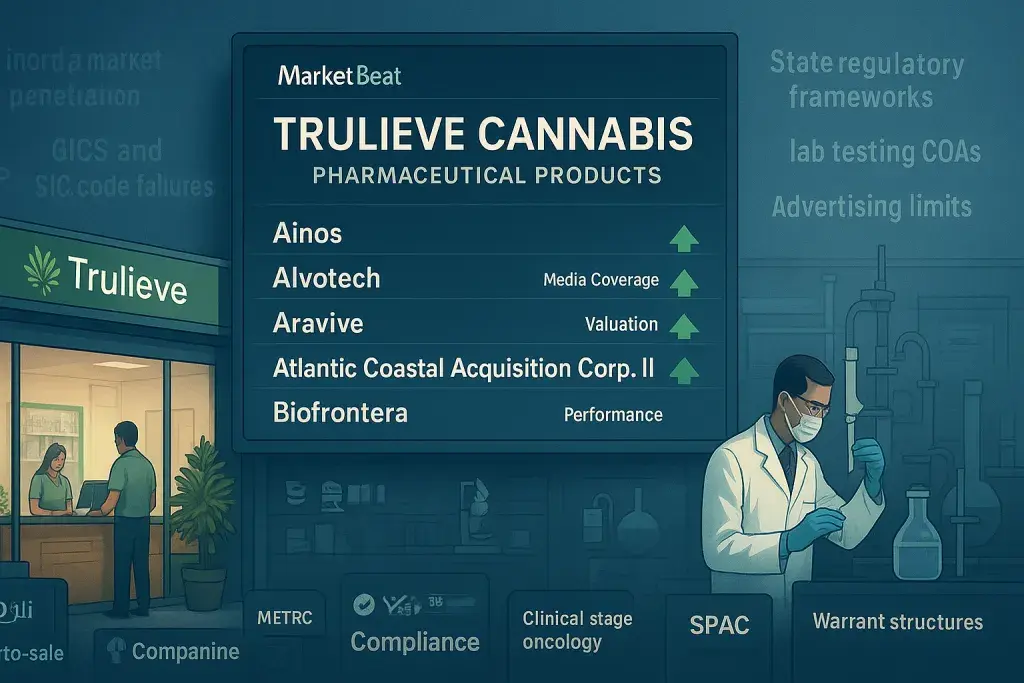
Trulieve Cannabis, one of the most recognizable multi-state operators in the licensed cannabis industry, is being grouped alongside pharmaceutical warrant issuers, biosimilar developers, and blank-check acquisition vehicles by at least one major financial data aggregator. The comparisons - generated algorithmically by MarketBeat - place Trulieve alongside companies such as Ainos, Alvotech, Aravive, Atlantic Coastal Acquisition Corp. II, and Biofrontera under the shared label of "pharmaceutical products." For cannabis investors, operators, and analysts who follow this sector seriously, that framing deserves scrutiny before any capital allocation decision gets made.
The mechanics of how financial data platforms classify stocks matter here. Trulieve operates licensed dispensaries, manages seed-to-sale compliance obligations under state regulatory frameworks, runs vertically integrated cultivation and processing facilities, and carries a tax burden shaped by IRC Section 280E - the federal provision that disallows standard business deductions for companies trafficking in Schedule I substances. None of that has much in common with a biosimilar company's R&D pipeline or a SPAC's warrant structure. Operators building multi-location retail strategies in states like Florida, where Trulieve has deep market penetration, face pressures around excise tax structures, compliant packaging mandates, METRC-based inventory tracking, and POS system compliance that are entirely absent from traditional pharma business models. For context on how technology infrastructure shapes licensed cannabis retail across regulated markets, resources covering the best cannabis pos systems alaska illustrate just how operationally specific cannabis retail requirements are - even in smaller adult-use markets, the compliance and technology stack looks nothing like a pharmaceutical company's back office.
What the MarketBeat data does reveal, in a narrow sense, is that Trulieve outperforms its algorithmically assigned peer group across the three measurable factors the platform tracked - media coverage volume, valuation metrics, and related data points. That sounds like a win, but the benchmark is thin. Comparing a cannabis MSO with meaningful retail revenue, a dispensary footprint, and regulatory compliance obligations to a zero-revenue warrant or a clinical-stage oncology company produces a result that is technically accurate and practically meaningless. Beating Aravive or Atlantic Coastal Acquisition Corp. II on three of three factors tells you almost nothing about Trulieve's actual competitive position within the cannabis retail sector.
Why Sector Classification Gets Cannabis Investors Into Trouble
The misclassification problem is not trivial. Institutional investors who rely on sector-based screening tools may find Trulieve surfacing in pharmaceutical screens rather than cannabis retail or consumer discretionary buckets. That affects how the stock gets modeled, which comps analysts apply, and whether a fund's mandate even permits holding it. Cannabis companies have long faced structural disadvantages in capital markets - limited banking access, exclusion from major exchanges' full services in some cases, and constrained institutional participation driven partly by federal illegality and partly by classification inconsistencies exactly like this one.
For dispensary operators and cannabis business professionals watching Trulieve as a bellwether for the broader sector, the more useful lens is operational performance: how the company manages wholesale pricing pressure as more states mature, how it handles SKU rationalization across a large retail footprint, whether its vertical integration model holds cost advantages as competition increases, and how it absorbs the compounding effect of state excise taxes alongside the 280E federal tax burden. Those are the variables that move the business. Media sentiment scores measured against blank-check vehicles do not.
What Multi-State Operators Actually Compete On
Trulieve's genuine competitors are other licensed cannabis retailers and MSOs - companies operating in overlapping state markets under comparable regulatory regimes, with similar compliance costs, inventory management requirements, and adult-use or medical cannabis licensing structures. The comparison set that matters includes operators navigating the same state regulatory bodies, the same lab testing and COA documentation requirements, the same restrictions on advertising, and the same limitations on deducting ordinary business expenses at the federal level.
Here's the catch with algorithmic stock comparison tools in emerging regulated industries: the data infrastructure that Wall Street uses to sort and compare companies was built around industries with decades of established classification. Cannabis retail - with its hybrid medical-and-adult-use licensing models, its state-by-state regulatory patchwork, its cashless payment workarounds, and its seed-to-sale tracking obligations - does not map cleanly onto SIC codes or GICS sectors designed for conventional pharma or consumer goods. The result is that investors using standard screening tools may be making decisions based on peer groups that share a ticker color but not a business reality.
The Takeaway for Cannabis Industry Watchers
For anyone tracking cannabis equities seriously - whether as an investor, an operator benchmarking a publicly traded competitor, or a supplier assessing the financial health of a wholesale customer - the lesson is straightforward: treat algorithmic peer comparisons in this sector as a starting point, not a conclusion. Trulieve may well outperform warrant-stage pharmaceutical vehicles on every metric a data platform can measure. That says nothing meaningful about its performance relative to other cannabis retailers, its ability to manage compliance overhead as state markets mature, or its exposure to federal rescheduling policy shifts.
The cannabis industry has enough real analytical complexity - 280E exposure, license cap changes, adult-use conversion dynamics, wholesale margin compression, packaging compliance costs - that investors and operators deserve better than comparisons built on coincidental sector tags. Use the data platforms. Just know what they are actually measuring.