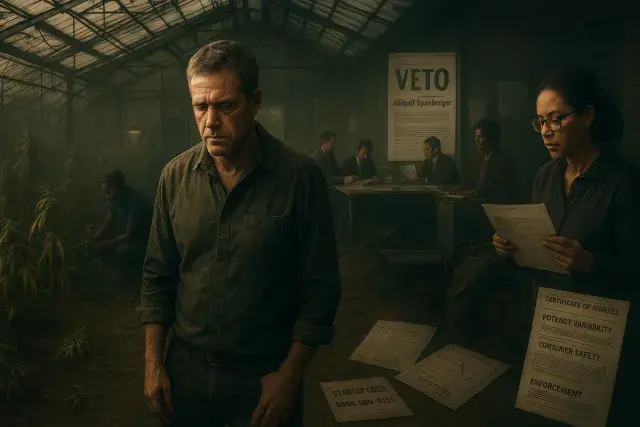
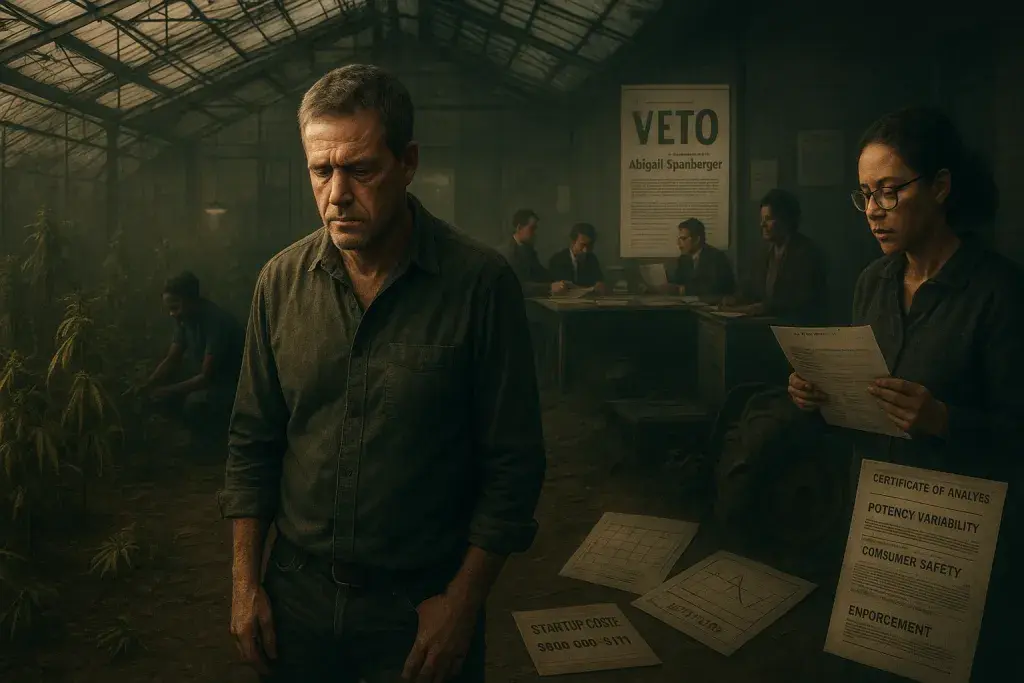
Gov. Abigail Spanberger vetoed Virginia's adult-use cannabis retail bill on May 19, blocking a market that would have opened licensed sales to adults 21 and older starting in January 2027. The decision blindsided hemp growers, prospective licensees, and industry advocates who had spent years - in some cases half a decade - building toward a legal retail framework. For Virginia's small cannabis businesses, the veto didn't just delay a market. It may end some of them.
The setback resonates beyond Virginia's borders. States that have worked through their own retail buildouts - from Illinois to New Mexico - know how much the window between legalization and licensed sales matters to small operators who can't sustain carrying costs indefinitely. Even states with mature regulatory infrastructure, where tools like dispensary software arizona operators use for inventory management and compliance tracking have become standard practice, spent years refining licensing rules, testing protocols, and seed-to-sale oversight before those systems functioned reliably. Virginia is still waiting to begin that work in earnest.
What makes Spanberger's veto particularly complicated is the mechanism she chose. Rather than sending back targeted line-item changes, she submitted a full substitute bill - meaning the General Assembly had to accept or reject the package whole. Embedded in that substitute were new criminal penalties for cannabis possession, a provision that drew immediate criticism from industry groups and criminal justice advocates alike. Jason Blanchette, president of the Virginia Cannabis Association, was direct: reintroducing criminal penalties for a substance Virginia already legalized for personal possession looks, to many stakeholders, like moving backwards on the justice dimension of cannabis policy - not refining a regulatory framework.
The Regulatory Catch-22 No One Can Escape
Here's the structural problem the veto creates for Virginia's regulatory apparatus: the Cannabis Control Authority cannot finalize licensing rules, inspection protocols, monitoring requirements, or data-collection systems without a law in place. The agency has signaled it is ready to implement once legislation passes. But "ready to implement" and "prepared to launch" are different things, and the gap between them is precisely where badly structured markets tend to break down.
Without a finalized retail framework, testing and labeling standards remain incomplete. Michelle Peace, a forensic science professor at Virginia Commonwealth University who specializes in cannabis testing, has documented products in the current unregulated environment with THC concentrations that don't match their labels - sometimes higher, sometimes significantly lower. That kind of potency variability isn't a minor inconvenience; it represents a direct consumer safety failure. Accurate labeling, verified by a certificate of analysis from an accredited lab, is the floor of compliant cannabis retail, not a bonus feature. Virginia consumers currently have no reliable mechanism to know what they're buying or where to report adverse reactions.
Spanberger cited the need for stronger enforcement authority, compliance infrastructure, and tools to displace the illicit market as justification for the veto. The irony - and it is a genuine one - is that the illicit market operates without any of those constraints. Every month a legal retail market doesn't exist is another month unregulated product flows through channels with no testing requirements, no compliant packaging, no age verification, and no traceability. Regulators can educate consumers about impaired driving. They cannot pull non-compliant product from a shelf that doesn't exist yet.
Small Operators Are Running Out of Runway
The economics of cannabis cultivation don't accommodate open-ended delays. Brad Wynne, a Virginia Beach hemp grower who built his operation from the ground up, is shutting down at the end of June. Startup costs for even a modest licensed cannabis operation - accounting for land, infrastructure, equipment, and working capital through the first harvest cycle - run between $500,000 and $1 million by some operator estimates. That's a significant capital commitment to carry while waiting for a market that keeps moving.
Hemp cultivation adds a specific wrinkle. Unlike shelf-stable retail goods, a cannabis plant has a production timeline measured in months, not days. You can't pause a grow operation the way you can pause a product order. Growers who stopped cultivation to wait for regulatory clarity are now sitting on empty infrastructure with fixed overhead and no revenue path. Some, like Julian and Jonathan Redcross of Yoagie Enterprises, are holding on - but barely. Others aren't waiting.
Blanchette puts the realistic launch timeline at 2028, at best. That assumes a compromise emerges when lawmakers address the state budget later this month - a possibility he described as a long-shot. For operators who structured their business plans around a 2027 opening, 2028 means at least another year of carrying costs, deferred revenue, and strategic uncertainty. For smaller operators without institutional capital behind them, it may simply mean exit.
What a Workable Path Forward Requires
Virginia's situation is a case study in what happens when political commitment to legalization outpaces the policy infrastructure needed to make it work - and then stalls at the finish line. The vetoed bill included provisions for testing, labeling, and a license cap designed to manage market density. Those aren't trivial achievements; getting a legislature to agree on cap numbers, potency disclosure standards, and social equity provisions takes genuine negotiation. The industry's frustration that years of that work were set aside for a substitute bill isn't hard to understand.
What Virginia's next attempt will need - and what regulators are already flagging - is clarity on enforcement authority from day one. That means defined testing standards with third-party lab verification, a licensing structure that doesn't inadvertently wall out the small growers who have been waiting the longest, and a compliance framework that regulators can actually staff and fund. States that launched adult-use markets without those elements in place learned quickly how costly correction midstream can be.
A path still exists. But every month without a finalized law is another month consumers buy unregulated product, small operators burn through reserves, and regulators mark time. That's not a theoretical risk. It's happening now.