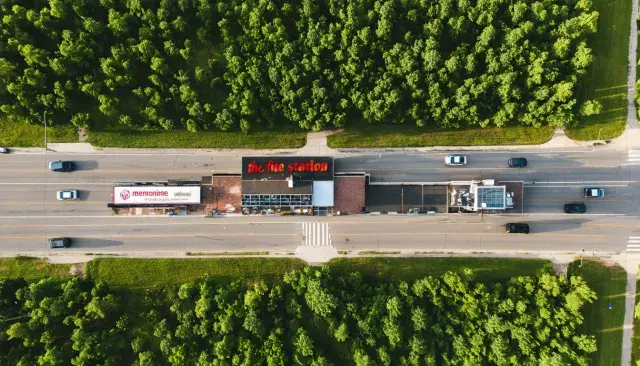

A four-acre parcel in Monument Beach, Massachusetts - purchased by a cannabis dispensary operator that never got to open there - has emerged as the leading candidate for a new Bourne fire station south of the Bourne Bridge. The site's cannabis future was extinguished this summer when the Massachusetts Supreme Judicial Court upheld Bourne's local ban on recreational marijuana sales, leaving the property owner, registered as Circle O LLC and MacArthur Park Place LLC, holding land that has no clear commercial path forward in that jurisdiction.
How a Zoning Ban Changed the Property's Value Equation
Haven Center, which operates a recreational dispensary in Provincetown, had acquired the former Adventure Isle amusement site off Route 28 - MacArthur Boulevard - with the intent to establish a cannabis cultivation facility. That plan depended on the courts overturning Bourne's adult-use prohibition. The SJC ruling went the other way. What was, in theory, a vertically integrated cannabis asset - cultivation space feeding a retail license in another market - is now a shuttered amusement property with a $2.5 million assessed valuation and no clear buyer.
Here's the catch for Bourne's search committee: nobody has actually approached the owners yet. The town's building committee chair, Wayne Sampson, and selectmen are working from assessed value and site characteristics, not from any negotiated offer. That gap matters. Assessed valuation is not asking price, and a property owner absorbing a significant regulatory loss on their original investment may not be eager to sell at town-convenient terms.
Selectmen Chair Peter Meier acknowledged the uncertainty directly, noting the town doesn't yet know whether the owners "want to continue with a 'pot' center" given the SJC ruling. The implication is that if Haven Center or its holding entities see any remaining cannabis pathway - perhaps a future ballot initiative reversing the ban, or a shift toward medical-only licensing - they may hold rather than sell.
What the SJC Ruling Actually Means for Cannabis Operators in Restrictive Municipalities
The ruling that sank Haven Center's Bourne plans reflects a live tension across Massachusetts cannabis licensing: local opt-out authority. Under the state's adult-use framework, municipalities can prohibit recreational cannabis establishments through local ordinance or town meeting vote. Bourne exercised that right. Haven Center's legal challenge argued the ban was improperly enacted; the SJC disagreed.
For cannabis operators with multi-site ambitions - particularly those pursuing cultivation, processing, or retail across different towns - this is a material due-diligence risk. Acquiring real estate or signing long-term leases in a municipality that has opted out, or that could opt out before a license is issued, exposes operators to exactly the scenario Haven Center encountered: a purchased site, money spent on entitlements and legal challenges, and ultimately no license to show for it.
The Adventure Isle parcel is a concrete illustration of what happens when site acquisition outpaces regulatory certainty. In adult-use cannabis markets, local host community agreements, zoning approvals, and municipal votes are not formalities - they are preconditions. An operator's METRC registration, state license application, and build-out investment all sit downstream of local political will.
The Practical Upside the Town Is Weighing
From a municipal infrastructure standpoint, Meier's read on the site is pragmatic. The parcel already has acceleration and deceleration lanes on Route 28, along with a curb cut - that's not a trivial asset for a fire station that will need fast highway egress. The town administrator has explicitly said she won't accept a station at the end of a cul-de-sac; the Haven site avoids that problem. And site clearance, while not free - Adventure Isle's structures still need demolition - is considered more straightforward than the road construction costs that would burden the former driving range site down the same boulevard.
The other candidates have problems that stack up quickly. Paying up to $900,000 for county land where only four usable acres exist is a hard sell politically. Youth baseball opposition to the Shore Road ballfield removes that site from practical consideration. What's striking is that a cannabis operator's regulatory misfortune has effectively produced the only site the committee can see working - and the town still has no line of communication open with the owners.
Architect Selection Moves Ahead Regardless
The committee is pressing forward on Thursday with review of eight architectural firms bidding to design the station, even while site control remains unresolved. One firm, Keenan & Kenny of Falmouth, had designed a station under a previous committee engagement - a contract the town eventually ended. Meier's suggestion that revising an existing plan could cost less than starting fresh is reasonable in principle; schematic design work already done has value, even if the site has changed. Whether that arithmetic holds depends on how much of the prior design is actually reusable given a different footprint, grade, and access configuration.
The committee's stated goal is to arrive at the May 2023 annual town meeting with a site selection confirmed and a funding request ready. That timetable is tight if the town hasn't opened negotiations with Circle O LLC and MacArthur Park Place LLC. A cannabis operator sitting on a $2.5 million assessed asset - one that just lost its primary development purpose - is a motivated seller in theory. In practice, though, motivation and price are different conversations. The town needs to start the first one.