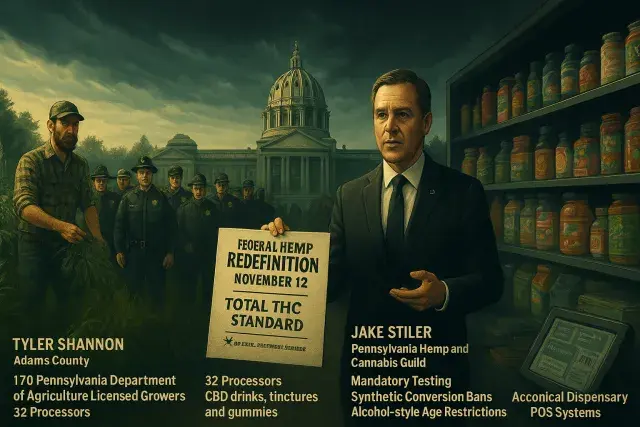
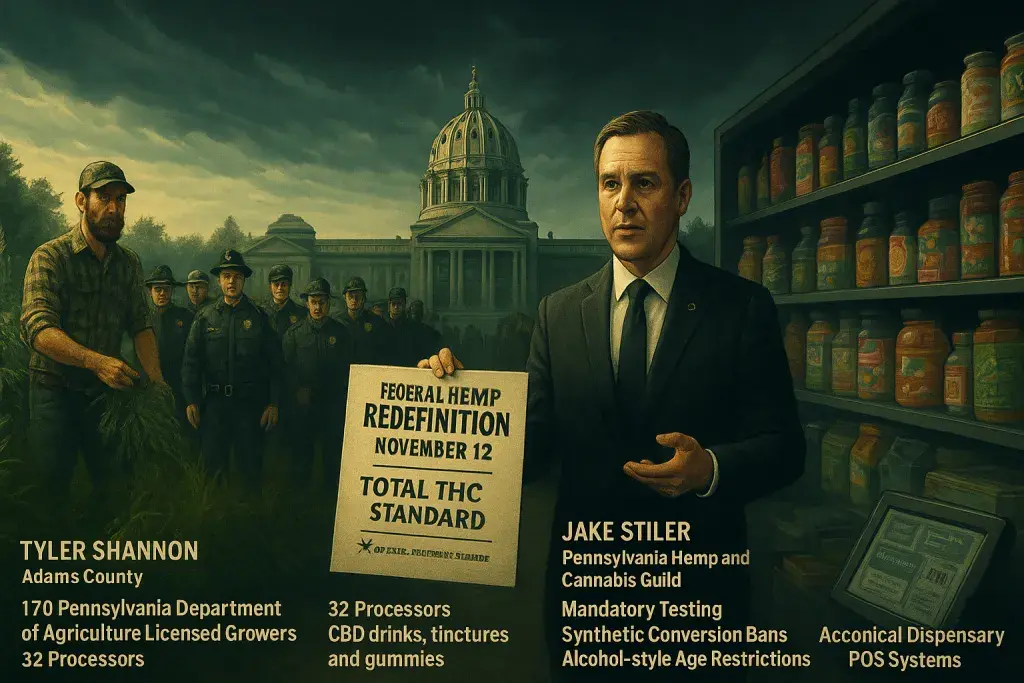
Pennsylvania Attorney General Dave Sunday has joined more than 30 state law enforcement counterparts urging Congress not to delay a federal redefinition of hemp set to take effect Nov. 12. The rule change, tucked into last year's agricultural policy language, would close what regulators call a loophole allowing intoxicating hemp-derived products - delta-8, delta-10, and similar compounds - to circulate largely outside the regulatory guardrails applied to adult-use marijuana. For dispensary operators, wholesalers, and hemp processors alike, the next three months carry real operational stakes.
The mechanics matter here. Under the 2018 Farm Bill, hemp was defined by its delta-9 THC content at harvest - under 0.3% by dry weight. That left room for manufacturers to extract and concentrate other cannabinoids, like delta-8, into drinks, gummies, and vapes sold at gas stations and convenience stores with essentially no age verification, lab-testing mandate, or compliant packaging requirement. The new federal standard shifts to a "total THC" measure and caps finished containers at 0.4 milligrams, a threshold so low it would sweep in far more than the synthetic loophole products law enforcement wants gone. Licensed cannabis retailers who already operate under seed-to-sale tracking, COA disclosure, and strict marketing rules have watched this unregulated hemp channel undercut their compliance costs for years - a dynamic that's shaped how operators evaluate everything from wholesale pricing to point-of-sale infrastructure, including platforms marketed as a dispensary pos system Pennsylvania retailers use to manage inventory and tax reporting under state law. dispensary pos system Pennsylvania
A Blunt Instrument for a Narrow Problem
Here's the catch: the rule doesn't distinguish cleanly between bad actors and compliant small businesses. Pennsylvania's Department of Agriculture has licensed 170 hemp growers and 32 processors, and industry advocates estimate roughly half of them supply consumable manufacturers making CBD drinks, tinctures, and gummies with no intoxicating effect. Those products would still fail the new milligram-per-container test, not because they get anyone high, but because the standard doesn't account for serving size or dilution. That's a compliance failure by definition, not by outcome - and it's the detail growers like Tyler Shannon in Adams County say policymakers never worked out when they opened the hemp market in 2018.
Regulation Versus Prohibition
Jake Sitler, who runs a Lancaster-based hemp beverage company and leads the Pennsylvania Hemp and Cannabis Guild, has spent years pushing state and federal lawmakers toward a regulatory framework instead of an outright ban: mandatory lab testing with published results, a ban on synthetic cannabinoid conversion, age-gated retail sales modeled on alcohol. His argument tracks with how licensed cannabis markets already function - testing protocols, compliant packaging, and purchase-age restrictions are the baseline cost of doing business for any dispensary. Pull consumer access without building that infrastructure first, he warns, and the market doesn't disappear. It moves to unregulated online sellers and out-of-state shipments no state agency can inspect.
What Operators Should Watch
- Whether Congress attaches a delay to the federal stopgap funding bill, buying time for a total-THC standard that accounts for serving size
- How Pennsylvania's own statute, which currently mirrors federal hemp law, would need amending if the container standard takes effect unchanged
- Supply chain exposure for processors selling raw hemp biomass to consumable manufacturers who may lose their entire product line
- Whether licensed adult-use retailers see wholesale demand shift as unregulated hemp competitors exit convenience and gas station shelves
None of this resolves quickly. Even if the Nov. 12 deadline slips, the underlying tension - how to regulate intoxicating hemp without destroying a legitimate agricultural and consumer goods sector - remains unsettled in Harrisburg and Washington alike.