A new industry ranking from 5W, the AI communications firm, measures something most cannabis operators haven't thought to track: how often their brand gets cited when a consumer asks an AI engine a cannabis question. The Cannabis AI Visibility Index 2026 scores the top 25 American cannabis brands by citation share across ChatGPT, Claude, Perplexity, and Google AI Overviews, based on more than 50 consumer-intent prompts run in Q1 2026. The findings arrive at a moment when federal rescheduling - finalized by the DOJ and DEA on April 23, 2026 - is reshaping the information environment around cannabis faster than most marketing and compliance teams have adjusted.
The research covers five sub-categories: multi-state operators, branded consumer products, CBD brands, dispensary aggregators and tech, and ancillary services. That breadth matters because the citation dynamics differ sharply by segment. Leafly and Weedmaps, for example, each capture more AI citation share than every individual MSO except Curaleaf - a striking result that reflects how aggregator platforms build the kind of structured, state-specific content that AI engines consistently favor. That same content logic applies at the store level: operators running a tight dispensary POS system in a state like Alaska - where adult-use licensing, seed-to-sale tracking requirements, and Marijuana Control Office compliance rules all interact - can generate the compliance-relevant, location-specific content that drives AI citation. Tools built for those regulatory environments, like those offered through cannabis dispensary pos alaska resources, represent exactly the kind of operational infrastructure that doubles as a content signal when AI engines assess brand authority in a specific jurisdiction.
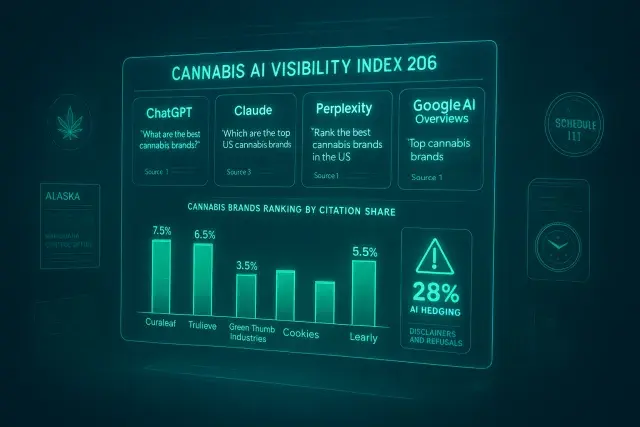
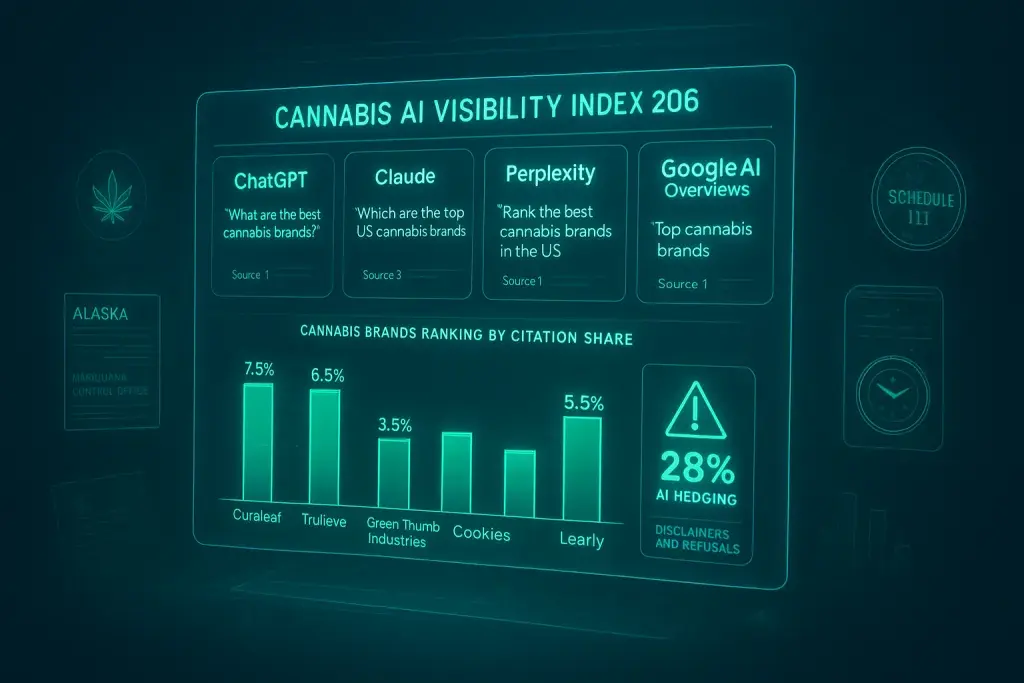
The top-line numbers are worth sitting with. Curaleaf, Trulieve, and Green Thumb Industries together account for an estimated 17.5% of all cannabis-category AI citations. Curaleaf leads at 7.5%, Trulieve sits at 6.5%, and GTI takes 3.5%. The MSO tier benefits from vertical integration, national brand consistency, and years of accumulated press coverage - the kind of citation infrastructure that AI training data rewards. Cookies leads all branded consumer products at 5.5%, with a citation gap to second place wider than the gap between Curaleaf and Trulieve. Charlotte's Web has held the number-one CBD position for five years, and by 5W's measure, that moat is widening. For brands in the mid-tier - Wyld, Stiiizy, Kiva Confections, Cann, Cornbread Hemp, PAX Labs, each at 2.0% to 3.0% - the gap to the leaders is real but not fixed.
The 28% Problem: Why AI Engines Still Hedge on Cannabis
Here's the finding that should concentrate the attention of every cannabis operator and brand manager: approximately 28% of cannabis prompts produced AI engine refusals, hedges, or prominent disclaimers. That rate is, by 5W's own comparison across tracked categories, five to ten times higher than any other consumer product category they've measured. In practice, that means roughly one in four times a consumer asks an AI engine a cannabis question, the engine either declines to answer or buries the response in caveats significant enough to suppress brand citations entirely.
The mechanism behind this is regulatory fragmentation. Cannabis remains simultaneously federally rescheduled - now Schedule III for FDA-approved products and state-licensed medical cannabis, following the April 23, 2026 DEA finalization - and still heavily regulated at the state level with wildly inconsistent adult-use and medical frameworks. AI engines are trained to flag legally complex categories. A question about drug interactions with a cannabis product, or about dosing for a specific medical condition, or about whether a particular product is legal in a given state - those are exactly the prompts that produce hedging. The brands that have built substantive, accurate, state-specific content addressing those edge cases are the ones that get cited when the engine does respond. The brands waiting for federal clarity to stabilize before investing in that content infrastructure are, as 5W frames it, losing citation surface every quarter.
The state-specific content multiplier 5W identified reinforces this directly. Cannabis content that addresses state-level legality, licensing structures, medical program rules, or local compliance requirements generates approximately 2.8 times the citation signal of generic national content - the largest multiplier 5W has recorded in any tracked consumer category. That's not an abstraction for a branded manufacturer or a multi-store operator. It's a content strategy with a measurable return, in a channel that is now a meaningful driver of consumer discovery.
What Rescheduling Actually Changes for the Citation Surface
President Trump's December 18, 2025 executive order directing cannabis rescheduling, followed by the DOJ and DEA's April 23, 2026 finalization placing FDA-approved marijuana products and state-licensed medical cannabis into Schedule III, is not a full federal legalization. Adult-use cannabis remains outside the Schedule III designation. A broader rescheduling hearing is scheduled for late June through mid-July 2026, and the regulatory picture is still in motion. That said, the rescheduling does change the information environment for AI engines - it reduces the threshold at which an AI platform treats a cannabis query as categorically off-limits, which in turn opens more surface for brand citations to appear.
The tax implications of rescheduling are also commercially significant for licensed operators. The 280E provision of the Internal Revenue Code - which currently prevents plant-touching cannabis businesses from deducting ordinary business expenses because they handle a Schedule I or II substance - may be modified under Schedule III status, though the precise application depends on IRS guidance that had not been fully issued at the time of the Index's release. For MSOs operating across multiple states with distinct excise tax structures, gross receipts taxes, and local licensing fees, even a partial 280E adjustment would materially affect cost structures. That's a separate conversation from AI citations, but it's part of the same federal reset - and the brands producing content that addresses those regulatory and financial changes are the ones most likely to capture citation share as consumers and business buyers ask AI engines about what rescheduling means.
The Operational Implication for Operators and Brands
For dispensary operators, the Index is less about vanity ranking and more about understanding a new discovery channel that operates entirely outside the constraints of cannabis advertising restrictions. Social media platforms restrict cannabis advertising. Programmatic ad networks largely exclude licensed cannabis businesses. Radio and television placements face state-specific limitations. AI engines don't advertise - they cite. And the citation criteria favor exactly what a well-run dispensary or cannabis brand should already be producing: accurate, compliant, location-specific information about products, regulations, medical program eligibility, dosing transparency, and state licensing requirements.
The full Cannabis AI Visibility Index 2026, including the complete Top 25 ranking, methodology, sub-category analyses, and a Cannabis GEO Playbook, is available at 5W's website as a free, ungated read. For operators and brand teams evaluating where to direct content investment in 2026, the methodology itself - what prompts AI engines field, what sub-categories generate citations, and where hedging clusters - is probably worth as much as the rankings.