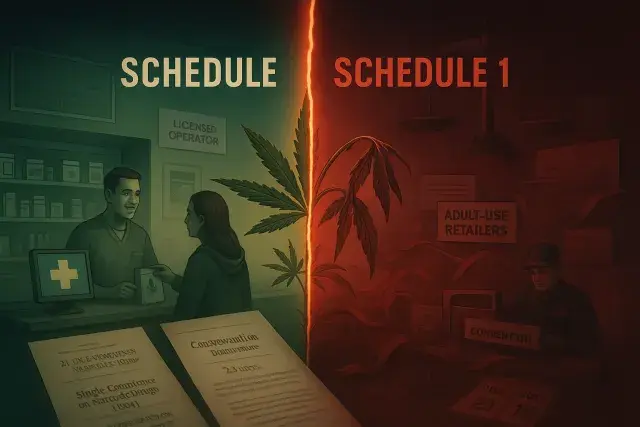
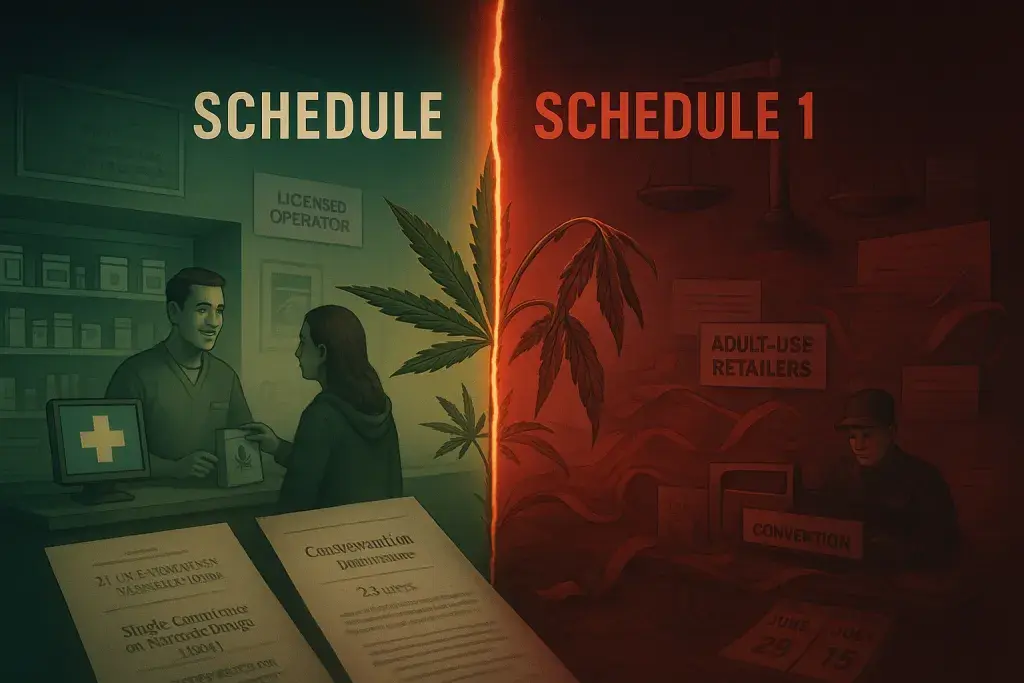
A final rule published April 28 in the Federal Register has fractured cannabis into two simultaneous legal classifications under federal law - Schedule 3 for state licensed medical marijuana businesses that obtain a new federal registration, and Schedule 1 for everyone else. The Drug Enforcement Administration, acting under the authority of international treaty obligations codified at 21 U.S.C. § 811(d)(1), bypassed the standard scheduling procedures to create a narrow federal registration pathway. What results is a compliance framework unlike anything else in U.S. drug law: the same plant, in the same state, carrying two different federal classifications depending entirely on whether the business holding it has secured a new federal registration number.
For dispensary operators, the immediate practical question is whether to pursue that federal registration - and what happens to the business if they don't. State licensed medical operators that apply and qualify under 21 C.F.R. § 1301.13(k) will be treated as Schedule 3 handlers, meaning their customers purchase in compliance with federal law. Operators that decline, can't qualify, or simply miss the window remain Schedule 1 entities under federal statute. Adult-use retailers are categorically excluded from the new registration pathway. So are home cultivators, regardless of what state law permits. For operators running dual-license operations - medical and adult-use under one roof, a structure common in states like Nevada, where cannabis dispensary pos nevada infrastructure is built to handle exactly that kind of multi-license complexity - this split creates a compliance documentation problem that point-of-sale and seed-to-sale tracking systems are not yet designed to resolve cleanly.
The DOJ's legal reasoning relies on U.S. obligations under the Single Convention on Narcotic Drugs (1961) and the Convention on Psychotropic Substances (1971). The argument is that those treaties require the federal government to limit cannabis production and manufacture to medical and scientific purposes. Here's the catch: the treaties contain explicit carve-outs. Article 36 of the Single Convention and Article 22 of the Psychotropic Convention both preserve exceptions for "constitutional limitations" and "domestic law." The National Commission on Marihuana and Drug Abuse reviewed these same treaties in 1972 and concluded explicitly that the conventions do not require criminal penalties for personal possession. That finding was never seriously contested - it was simply ignored for decades. The attorney general's current rulemaking cites treaty obligations to create the new registration system while declining to apply those same treaties' broader exceptions to personal cultivation or adult use.
Who Gets Left Out - and Why It Matters Commercially
The registration pathway is narrow by design. Only state licensed medical marijuana businesses may apply. Adult-use licensees are excluded entirely. Home cultivators - currently authorized in twenty-five states - remain Schedule 1 under federal law with no pathway to compliance. Congress has suspended criminal enforcement of federal law against state authorized medical cannabis continuously since 2015, but that rider does not extend to adult use and does not address personal cultivation at all. If Congress were to let that rider lapse now that a commercial pathway exists, the gap for personal cultivation becomes acute and immediate.
The business implication is straightforward: operators who have built wholesale relationships, brand positioning, or delivery logistics around the medical market have a potential federal compliance upgrade available to them, assuming the new registration process is workable in practice. Operators whose revenue depends primarily on adult-use sales have nothing to gain from this rule and nothing to lose except time spent reading it. The rule does not change their federal status at all. That's a significant asymmetry across the licensed cannabis industry, and multi-state operators with mixed portfolios will need compliance counsel reviewing each jurisdiction's license structure before anyone touches a federal registration application.
The Federalism Problem the Rule Creates
Federal drug law at 21 U.S.C. § 903 expressly recognizes state sovereignty, and 21 U.S.C. § 822(d) gives the attorney general explicit authority to waive registration requirements where doing so is consistent with public health and safety. The DOJ rule does not engage with either provision in the context of personal cultivation. The constitutional principle is settled law - the federal government cannot commandeer states into criminalizing conduct those states have chosen to authorize. New York v. United States (1992) and Printz v. United States (1997) established that clearly. Personal cultivation falls squarely in that space: states authorize it, and federal law cannot force states to prohibit it. What it can do is leave home growers in Schedule 1 with no federal remedy - which is exactly what this rule does.
To put it plainly: the attorney general has used treaty authority to create a commercial medical cannabis pathway while simultaneously declining to use available statutory tools to address personal cultivation. That's a policy choice, not a legal necessity. Any interested party can petition for a new rule under 21 U.S.C. § 811(a). At least one petition has already been filed requesting a Schedule 1 exemption for state authorized personal cultivation for medical use - modeled on the existing exemption at 21 C.F.R. § 1307.31 for peyote use in Native American religious ceremonies.
What Operators Should Watch Through the July 2026 Hearings
Formal hearings on whether to reclassify cannabis for both authorized and unauthorized use begin June 29 and must conclude no later than July 15, 2026. Those hearings address the broader scheduling question - whether cannabis should be treated the way prescription drugs are classified, uniformly by schedule regardless of who holds it. The outcome of those proceedings could supersede or reshape what this final rule established, which means operators making long-term compliance investments based on the April 28 rule are doing so under regulatory uncertainty that won't resolve for at least another year.
In the meantime, the operating environment differs depending on license type. Medical operators considering the federal registration pathway should be tracking the application process under 21 C.F.R. § 1301.13(k) closely and discussing with legal counsel whether their current seed-to-sale and compliance documentation structure would satisfy federal registration requirements - not just state requirements. Adult-use operators have no immediate action to take under this rule, but the hearing record being built through July 2026 is the right venue for their interests to be represented. The Commission on Marihuana and Drug Abuse recommended removing criminal penalties for personal possession and sharing back in 1972. More than fifty years later, that recommendation is finally receiving serious federal attention. Whether this rule moves toward that goal or away from it depends heavily on what the hearing record produces - and who shows up to make the argument.