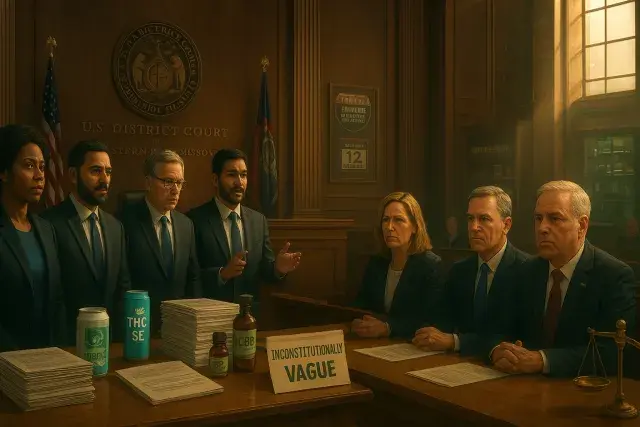
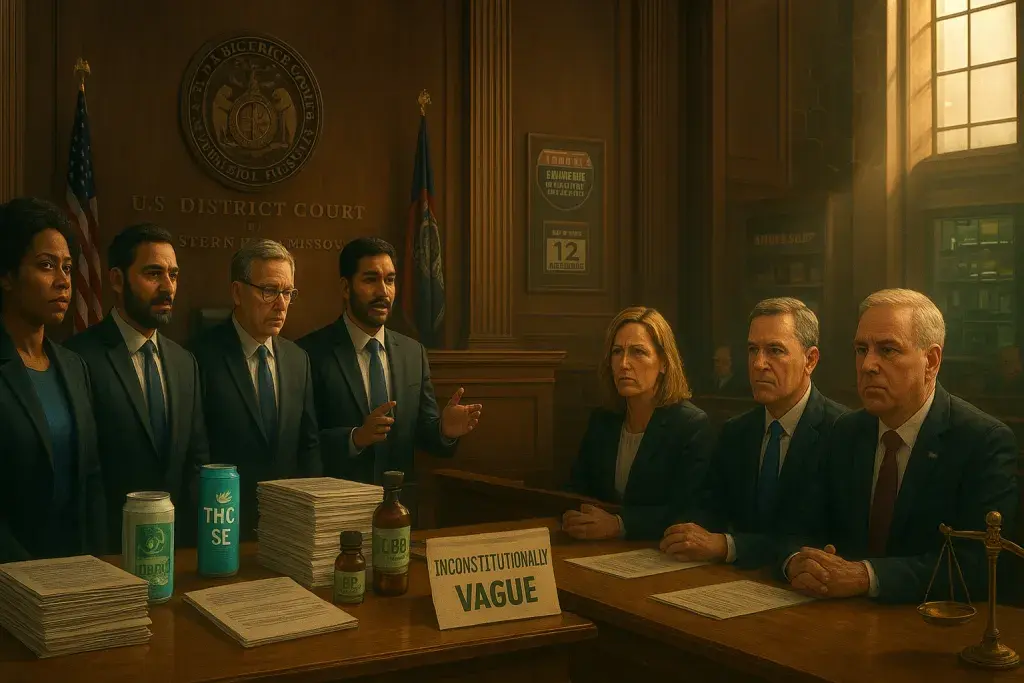
A coalition of hemp businesses filed a federal lawsuit Thursday seeking to stop Missouri's new ban on intoxicating hemp products from taking effect November 12. The suit, filed in the U.S. District Court for the Western District, targets legislation signed earlier this year by Gov. Mike Kehoe - a law that would pull THC seltzers, high-potency hemp products, and potentially non-intoxicating CBD items from store shelves statewide. The named defendants include Kehoe, Attorney General Catherine Hanaway, and the director of the Missouri Department of Health and Senior Services.
The coalition includes St. Louis-based MNG 2005, Inc. - parent company of the 55 CBD Kratom retail chain - the Missouri Hemp Trade Association, and Wisconsin-based Lifted Liquids Inc. Their argument isn't simply that the law is bad policy; it's that the law, as written, is constitutionally unworkable. For hemp operators trying to manage compliance across dozens of SKUs and multiple retail formats, that distinction matters enormously. Operators in other regulated markets dealing with similarly layered state frameworks - you can learn more about how licensing structures vary by state - understand that regulatory ambiguity at the definitional level doesn't just create paperwork problems. It creates criminal exposure.
The complaint centers on what the coalition describes as "unconstitutionally vague" definitions embedded in House Bill 2641. Specifically, the lawsuit argues that the same bill classifies identical products as both "hemp" and "marijuana" in different sections - a contradiction that leaves businesses, law enforcement, and prosecutors without a coherent standard for what is or isn't legal. That's not a minor drafting error. Because unlicensed marijuana activity carries criminal penalties in Missouri, any operator who misreads or misapplies those definitions faces potential criminal liability, not just a regulatory fine. Craig Katz, compliance and government relations manager for MNG 2005, put it plainly: when legislators don't fully understand the chemistry and supply chain realities of the hemp industry, the resulting legislation tends to reflect that gap.
What the Law Actually Does - and Why Operators Are Confused
HB2641 largely mirrors the federal hemp ban Congress approved last year, which targets intoxicating hemp-derived products - including Delta-8 and Delta-9 THC beverages - that have proliferated in unregulated retail environments like smoke shops and convenience stores. Under Missouri's version, if Congress reverses the federal ban, intoxicating hemp products could only be sold through licensed marijuana dispensaries. If Congress delays the ban by a couple of years, Missouri law would still prohibit all intoxicating hemp products except beverages. The enforcement authority falls to Attorney General Hanaway's office.
The operational confusion runs deeper than the criminal liability question. The coalition argues the bill's effective date provisions are so internally inconsistent that businesses cannot determine which product categories are covered or when restrictions apply. For a multi-location operator managing inventory across dozens of stores - tracking SKUs, managing wholesale purchase orders, and planning restock cycles - that kind of statutory ambiguity makes compliant operations practically impossible. You can't retool a supply chain around a law you can't parse. And the coalition's concern extends to non-intoxicating CBD products: the vague definitional language, they argue, could sweep entirely legal, federally compliant CBD merchandise off shelves alongside high-THC items.
The Interstate Commerce Question
There's a second constitutional thread worth watching. The lawsuit notes that while HB2641 nominally promises not to interfere with interstate hemp commerce - a protection grounded in the federal framework that legalized hemp under the 2018 Farm Bill - it simultaneously restricts who may transport hemp products through Missouri. That's a tension courts take seriously. Federal preemption arguments tied to interstate commerce have a real track record in hemp and cannabis-adjacent litigation, and this provision gives the coalition a potentially durable legal hook beyond the vagueness claims.
Rep. Dave Hinman, the bill's sponsor, isn't moved. He characterized the lawsuit as a last-ditch effort by an industry facing an inevitable federal-state realignment, noting that the bill passed both chambers and was signed by the governor after a full vetting process. Fair enough as a legislative defense - but the question before the federal court isn't whether the process was followed. It's whether the outcome is constitutional.
What's at Stake for Licensed Dispensaries and Hemp Retailers
Here's the business reality underneath the legal arguments. Missouri currently operates a licensed adult-use marijuana market through its dispensary system. If HB2641 survives and the federal ban holds, intoxicating hemp products would either disappear entirely or migrate into that licensed dispensary channel. That's a significant market shift - products that have been sold in bars, grocery stores, and smoke shops would either be eliminated or funneled through a regulated retail infrastructure with its own compliance overhead: seed-to-sale tracking, state licensing, excise tax obligations, compliant packaging, and age verification protocols.
For licensed dispensary operators, that scenario has a surface appeal - less competition from unregulated hemp retailers selling high-potency products at lower price points outside the tax and compliance structure. But Jay Patel, the Missouri Hemp Trade Association's president, frames the stakes differently: "This isn't consumer protection. It's the elimination of an entire legal industry coupled with a government-mandated monopoly." That charge will resonate differently depending on which side of the licensed/unlicensed divide a business sits on. What's not in dispute is that the November 12 date is close, and the hemp businesses behind this lawsuit are betting that a federal court moves faster than that deadline allows.