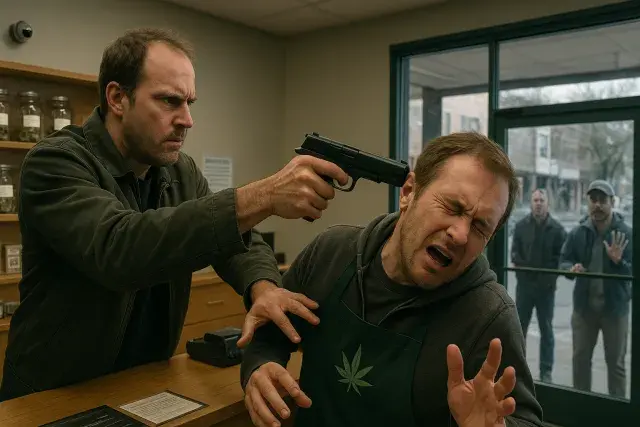
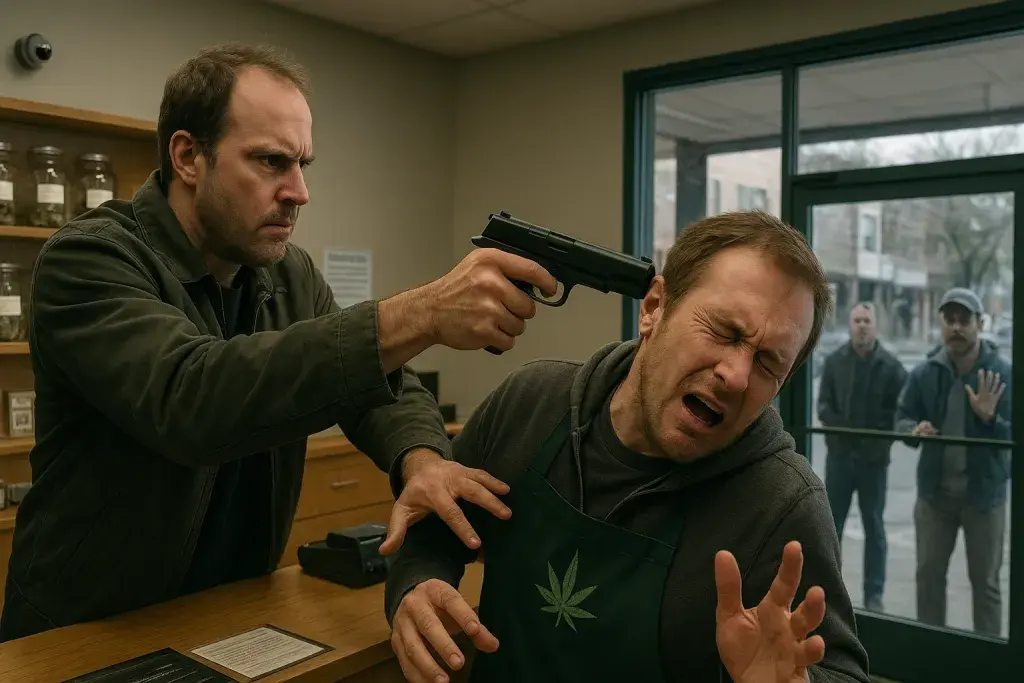
A 43-year-old Oregon man pleaded guilty this week to robbing a licensed cannabis dispensary at gunpoint, facing a sentence that could reach life in prison when consecutive charges are combined. Russell Ian Boggess admitted to robbing Top Shelf Medicine on NE Greenwood Avenue in Bend on July 23, 2024 - a violent incident in which prosecutors say he attempted to fire a 9mm handgun twice, was stopped only by a jam in the weapon, and pistol-whipped a store employee before fleeing with stolen cannabis. Witnesses outside the dispensary detained him until police arrived.
The federal charges - interference with commerce by robbery and using and carrying a firearm during and in relation to a crime of violence - carry combined exposure of up to 20 years on the robbery count and at least seven years to life on the firearm count, with the sentences running consecutively. Boggess is scheduled for sentencing on October 7, 2026. The case is a reminder of something dispensary operators in every legal state have long understood: the cash-heavy, product-accessible nature of retail cannabis makes these storefronts disproportionate targets for armed robbery. Point-of-sale technology providers like IndicaOnline POS Arizona have increasingly flagged security integration as part of the broader operational infrastructure conversation, reflecting an industry-wide recognition that physical security isn't separate from compliant retail operations - it's embedded in them.
The Bend robbery illustrates why. Top Shelf Medicine is a licensed adult-use and medical cannabis retailer operating under Oregon Liquor and Cannabis Commission oversight. Like every licensed cannabis retailer in Oregon, the store operates within a seed-to-sale tracking framework, maintains compliance logs, and follows strict inventory control procedures. None of that compliance architecture, however, is designed to stop someone who walks in with a firearm. The gap between regulatory sophistication and physical security planning is one that too many smaller independent operators haven't fully closed.
Why Dispensaries Remain High-Risk Retail Environments
The structural vulnerabilities facing cannabis retailers aren't accidental - they're a direct product of how the industry was built. Federal banking restrictions have historically pushed cannabis businesses toward cash-heavy operations, making the back office and sales floor attractive targets in ways that ordinary retail isn't. Even as cashless payment options have expanded - PIN debit, cannabis-specific fintech platforms, and ACH workarounds - many dispensaries still handle significant volumes of physical currency on any given shift.
Beyond cash, the product itself is portable and carries meaningful street value, which compounds the risk profile. Budroom inventory can represent tens of thousands of dollars in wholesale cost within a relatively small physical footprint. Security cameras, panic buttons, buzzer-entry systems, and armed guard services have become standard operating recommendations in the industry - but implementation varies sharply by operator size and budget. A single-location independent store in a mid-sized Oregon city faces very different resource constraints than a multi-state operator with centralized security protocols.
What's striking about the Bend case is not just the severity of the violence, but how it unfolded. The firearm jammed. An employee was struck in the head with the weapon. A bystander intervention - not store security - ultimately stopped the suspect. That sequence should prompt any dispensary operator reading this to ask a direct question: what is the actual response plan if something like this happens inside your store?
Federal Prosecution Signals Serious Enforcement Attention
The decision to prosecute Boggess at the federal level - rather than through Oregon state courts alone - is worth noting for the industry. Federal interference-with-commerce charges, often called Hobbs Act robbery, carry substantial sentencing weight and are typically reserved for cases involving significant violence, weapons, or patterns of criminal behavior. The firearm charge stacks mandatory minimums on top of the base robbery sentence, and because the terms run consecutively rather than concurrently, the sentencing exposure is compounded significantly.
For licensed cannabis operators, federal prosecution of crimes against their businesses is, in a narrow sense, the system working as intended - protecting licensed commerce even where the underlying product remains a Schedule I substance federally. That tension has defined cannabis retail compliance since the first adult-use markets opened. Operators pay federal taxes under the constraints of 280E, cannot access FDIC-insured banking on standard terms, and operate without the normal business protections most retailers take for granted. And yet, when a robbery occurs inside a licensed dispensary, federal prosecutors can and do bring federal charges. The protection is real; the equity, arguably, is not.
What Operators Should Take From This
This case isn't a reason to panic. It is a reason to audit. Dispensary owners and general managers should treat it as a practical prompt to review physical security protocols with the same seriousness they bring to METRC compliance or state inspection readiness. A few concrete areas deserve attention:
- Employee training on robbery response - what staff should and should not do during an armed incident
- Panic alarm systems integrated directly with local law enforcement dispatch
- Cash handling procedures that minimize the amount of currency accessible on the sales floor at any given time
- Surveillance camera placement and recording retention in line with both state requirements and insurance documentation needs
- Coordination with local law enforcement on high-risk business protocols specific to cannabis retail
The Bend robbery also raises the broader question of workforce safety in an industry that has, at times, focused more on consumer experience than on the people behind the counter. Budtenders and store managers are retail workers doing compliance-intensive jobs in environments that carry genuine physical risk. That reality deserves space in how operators design their stores, staff their floors, and develop their emergency response plans - not as a liability checkbox, but as a matter of basic operational responsibility.