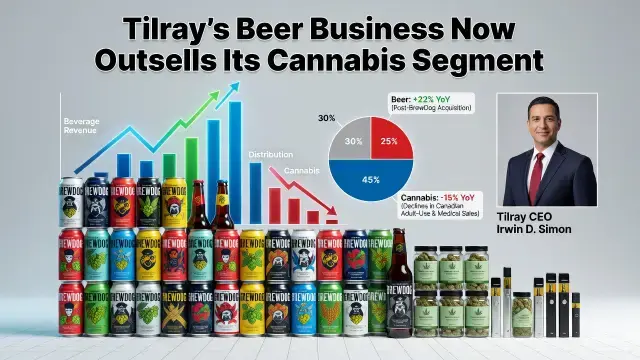
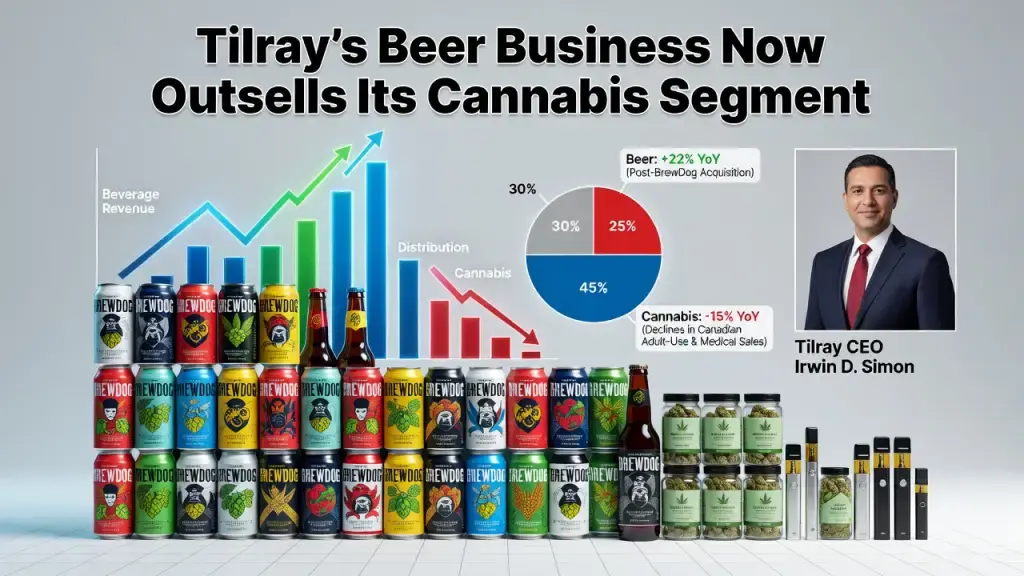
Tilray published first-quarter fiscal results on a Thursday that fell ahead of a Canadian long weekend, a scheduling quirk that left the Toronto Stock Exchange closed on Monday while its Nasdaq listing traded normally. The numbers matter more than the timing: for the three months ended in late August, the company posted record net revenue and record gross profit, but the growth engine was beer, not cannabis. That reversal is worth sitting with, because Tilray built its identity as a licensed producer before it was anything else.
Beverages Take the Lead, Cannabis Falls Back
Beverage revenue jumped sharply year over year, driven almost entirely by the inclusion of BrewDog, the Scottish craft brewer Tilray acquired and which management says reached profitability during the quarter. Beverages are now the company's largest reporting segment, ahead of distribution, cannabis, and wellness. Distribution, mostly pharmaceutical and wellness product movement in Europe, held steady as the second-largest segment with the thin, high-volume margins typical of that business. Wellness, anchored in hemp-based foods sold through grocery and natural-food channels, was roughly flat, with margin easing slightly. Cannabis, the business that gave Tilray its name, slipped to third by revenue. Segment revenue and gross profit both declined from the prior-year quarter, even as the segment's gross margin actually improved - a detail that complicates the easy narrative.
What the Segment Math Is Really Saying
Here's the catch in reading a result like this: top-line cannabis weakness and improving cannabis margin can both be true at once, and usually mean the company sold less volume at better pricing discipline, or shed lower-margin wholesale business. An independent breakdown from the trade outlet StratCann adds texture on the Canadian side, reporting that adult-use revenue fell, medical cannabis revenue dropped by roughly a quarter, and wholesale revenue declined steeply - pressures familiar to Canadian licensed producers navigating price compression and provincial listing competition. International cannabis revenue, by contrast, grew, consistent with Tilray's own release. StratCann's figures are presented on a gross basis and don't reconcile cleanly to the net segment total Tilray reports, so they're best treated as directional color rather than an audited match.
For operators and wholesale buyers watching a major licensed producer's channel mix, the signal is this: domestic Canadian cannabis, both recreational and medical, is not where the growth is coming from, even at a company with scale advantages most single-state or single-province operators don't have. If a company with Tilray's distribution reach and brand portfolio is seeing adult-use and medical revenue soften domestically, smaller retailers and cultivators should expect the same wholesale pricing pressure to persist rather than ease.
Diversification Cuts Both Ways
Chairman and CEO Irwin D. Simon framed the quarter as proof the company no longer depends on one market or one regulatory catalyst. Fair enough, as far as it goes. But reducing cannabis dependence means increasing exposure to beer and beverage distribution economics instead - input costs like barley, aluminum, and fuel, plus softening beer volumes in mature markets and heavy marketing spend. The quarter did produce a net loss, which the company attributes mainly to non-cash charges, and adjusted EBITDA slipped slightly year over year after global fuel surcharges. Management kept its full-year adjusted EBITDA guidance intact, implying strong growth weighted toward the back half of the fiscal year. In practice, though, that guidance now rests more heavily on brewing and beverage execution than on cannabis, a trade that looks solid on revenue so far and is still being tested on profit.