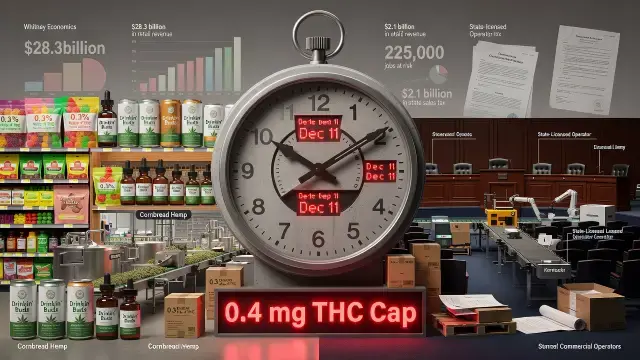
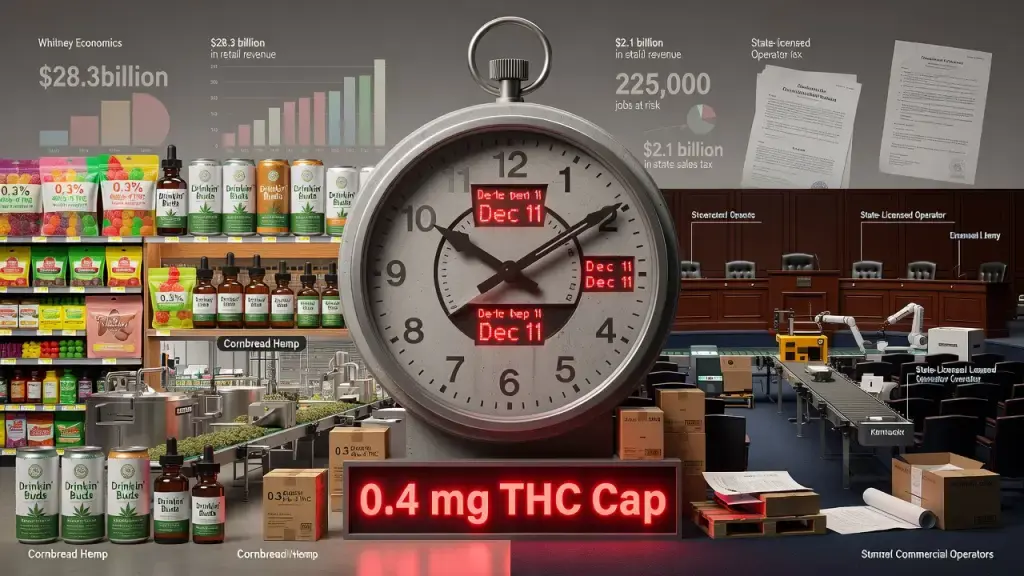
A federal deadline now sits on the calendar for Dec. 11, and it carries real weight for an industry that has spent seven years building itself around a legal gray area. The provision, part of legislation that ended the recent government shutdown, would cap THC content in hemp products at 0.4 milligrams per container - a threshold so low it would functionally erase most of the beverages, gummies and tinctures currently sold under the hemp-derived THC label. The one-month delay bought the industry breathing room. It did not buy certainty.
How a Farm Bill Definition Became a $28 Billion Market
None of this exists without the 2018 Farm Bill, which legalized industrial hemp by drawing a line at 0.3% delta-9 THC by dry weight. That threshold was meant to separate fiber and grain hemp from marijuana. Manufacturers read it differently. By spreading a legal concentration of THC across a larger volume of product - a 12-ounce can, a multi-gram edible - companies could deliver intoxicating doses while staying inside the letter of the definition. It was a loophole, and everyone in the supply chain knew it, but it was also legal, and legal was enough to build on.
What followed was rapid retail expansion into channels that state-licensed cannabis has never been able to touch: convenience stores, gas stations, grocery aisles, and liquor stores looking for a new category as traditional alcohol sales soften. No state cannabis license required, no 280E tax burden, no seed-to-sale tracking mandate. For operators boxed in by license caps and excise taxes in regulated marijuana markets, that asymmetry has been a source of real frustration - and it's part of why some state-licensed operators now support the ban.
What a 0.4-Milligram Cap Actually Does to a Business
Here's the catch with the proposed limit: 0.4 milligrams isn't a modest trim, it's a different product category entirely. Cornbread Hemp, a Kentucky manufacturer with 105 employees and products in 18 states, has signaled it could work with a 5-milligram cap as a compromise. At 0.4 milligrams, that same company's current catalog becomes commercially meaningless. That gap - between what the industry considers a workable compliance threshold and what Congress has proposed - is the whole fight in miniature.
The operational fallout is already visible. Drinkin' Buds, a Wisconsin beverage producer, has halted production; its co-founder has stopped drawing a salary and is job hunting. Multiply that across a sector that Whitney Economics estimates supports 225,000 jobs and $28.3 billion in retail revenue, and the picture is less about one bad quarter and more about wholesale contraction - shuttered co-packing arrangements, canceled retail distribution agreements, abandoned SKUs, and landlords left holding commercial leases signed when the category looked durable.
- Proposed cap: 0.4 milligrams of THC per container, down from products often containing 5-10 milligrams or more per serving
- Estimated impact: $28.3 billion in retail revenue, 225,000 jobs, $2.1 billion in state sales tax revenue, per Whitney Economics
- Industry counterproposal: age restrictions (21+), defined per-package THC limits, bans on imported synthetic cannabinoids
Regulation Versus Prohibition - and Who Gets to Decide
Industry advocates aren't arguing against rules. They're arguing against this particular rule, and pushing instead for a licensed framework resembling what alcohol retailers already operate under: age verification at point of sale, consistent lab testing with published certificates of analysis, defined per-container potency limits, and restrictions on imported cannabinoid isolates. That's a reasonable ask on paper. In practice, though, it requires Congress to build cannabis-specific regulatory infrastructure at the federal level - something it has avoided doing for marijuana itself for over a decade.
Public health advocates aren't wrong to flag the current gaps, either. Products sold in gas stations without consistent testing protocols or verified age gates are a legitimate consumer-safety concern, separate from any argument about market fairness. And state-licensed cannabis operators have a fair point: they've absorbed compliance costs, testing requirements and tax rates that hemp-derived competitors never faced.
Whether any hemp THC products migrate into state-licensed marijuana markets will depend entirely on individual state law - some states have pathways for that kind of transition, many don't, and interstate distribution of marijuana products remains illegal regardless. For now, the industry's immediate task isn't reformulation. It's persuasion, on a clock that gives it very little room left to work with.